
TeachMate AI
An Integrated AI-Powered Grading System & Teacher Guidance Automation for O/L ICT Education in Sri Lanka
Faculty of Computing, Sri Lanka Institute of Information Technology (SLIIT)
84.9%
Grading Time Saved
0.83
F1-Score
14.4%
Learning Improvement
Why TeachMate AI?
Sri Lanka's O/L ICT education faces critical challenges with the 2026 curriculum reforms. Traditional methods can't keep up.
Time-Consuming Grading
Teachers spend 15+ minutes per answer sheet manually grading, leaving little time for teaching.
Delayed Feedback
Students receive feedback weeks after exams, missing the critical window for effective learning.
Generic Instruction
One-size-fits-all teaching fails to identify and address individual student learning gaps.
84.9% Faster Grading
VLM-based OCR and semantic grading automate answer sheet evaluation in just 2.3 minutes.
Precision Gap Detection
BKT + GNN knowledge graphs identify concept-level weaknesses with 0.83 F1-score accuracy.
Personalized Learning
AI-generated study plans deliver 14.4% improvement in learning outcomes, statistically verified.
Research Domain
Explore our literature foundations, identified research gaps, objectives, methodology, and technology stack.
Automated Assessment & Grading
Traditional assessment methods are time-consuming and prone to human error. Recent advances in NLP, particularly transformer-based models like BERT, achieve accuracy comparable to human graders for short written answers (Ramesh & Sanampudi, 2022). Vision-Language Models (VLMs) now enable simultaneous perception of layout and text for complex handwritten documents.
Knowledge Representation & Learning Analytics
Knowledge graphs model prerequisite relationships between concepts (Chen et al., 2017). Bayesian Knowledge Tracing (BKT) estimates student mastery over time using four parameters. Graph Neural Networks (GNNs) outperform traditional BKT by capturing complex concept dependencies through message-passing operations (Nakagawa et al., 2019).
Adaptive Learning & Personalization
Personalized learning systems tailor content and pacing to individual needs. Mobile learning applications significantly improve student motivation and flexibility (Crompton & Burke, 2018). The ResourceCompletionPredictor pattern using logistic regression represents an emerging approach to adaptive resource sequencing.
Bloom's Taxonomy in Assessment Design
Bloom's Taxonomy remains the dominant framework for designing assessments with cognitive complexity. Automated classification using fine-tuned DistilBERT achieves over 90% accuracy (Goel & Singh, 2023). Our work extends this by combining cosine similarity with keyword-boosting heuristics.
System Architecture
A modular, microservice-based architecture with four interdependent AI components working as a unified ecosystem.

Frontend Layer
React.js web interface for teachers · React Native mobile app for students
Backend Layer
RESTful APIs via Flask & FastAPI · Dedicated microservices per component
Data Layer
Firebase Realtime Database · Neo4j Knowledge Graph · Real-time sync
AI/ML Layer
VLM OCR · Sentence-BERT · BKT + GNN · DistilBERT · Logistic Regression
All components communicate through a centralized API gateway with continuous feedback loop
Intelligent Components
Four synergistic AI-powered modules that work independently and as a unified ecosystem to automate the complete teacher–student feedback loop.
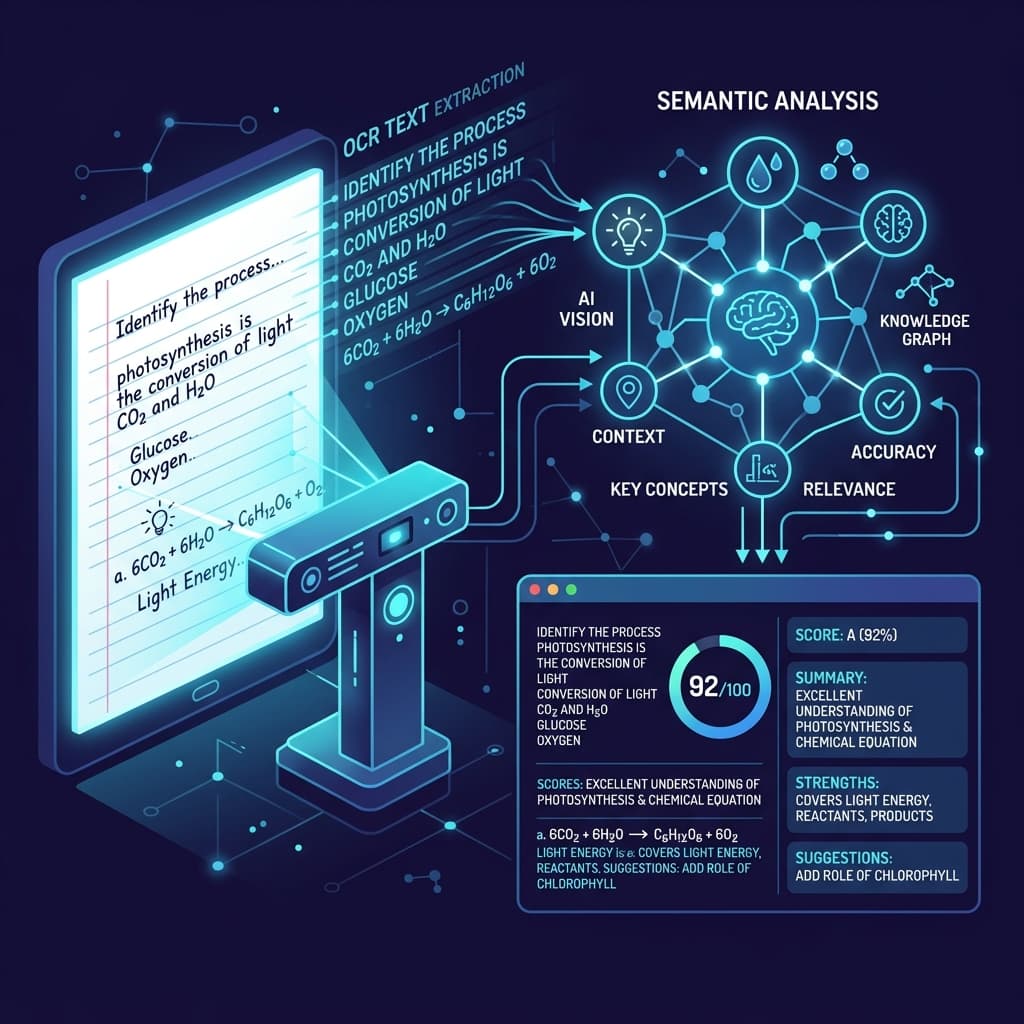
VLM-Based OCR & AI Grading
Automates evaluation of handwritten O/L ICT answer sheets using Qwen2-VL-7B-Instruct Vision-Language Model with Sentence-BERT semantic similarity scoring.
Technologies
Key Results
- 4-bit NF4 quantization — reduces GPU memory from 14GB to <5GB
- Multi-method semantic evaluation (BERT + ROUGE + Keywords)
- 96.8% OCR accuracy with VLM fallback
- 87.3% agreement with human graders within ±2 marks
- Constructive natural language feedback generation
Research Results
Evaluated across 2 schools, 120 Grade 11 students, and 6 ICT teachers over one academic term in Sri Lanka's Western Province.
0%
Grading Time Reduction
15.2 min → 2.3 min per sheet
0.00
F1-Score (GNN+BKT)
Outperforming all baselines
0%
Bloom's Classification
90%+ with fine-tuned DistilBERT
0.0%
Learning Improvement
vs 6.4% control group (p<0.001)
Additional Metrics
120
Students Evaluated
87.3%
Grading Agreement (±2 marks)
68.3%
Recommendations Accepted
91.7%
Mobile App Adoption
12.5h
Weekly Time Saved per Teacher
18.4%
Score Increase in Weak Topics
Learning Outcome Comparison
| Group | Pre-Test | Post-Test | Improvement |
|---|---|---|---|
| Control Group (n=60) | 52.3% | 58.7% | +6.4% |
| AI LMS Group (n=60) | 51.8% | 66.2% | +14.4% ✓ |
Independent samples t-test: t(118) = 3.42, p < 0.001 — statistically significant
Project Milestones
Key assessments and deliverables throughout our research project timeline.
Project Proposal
CompletedInitial project proposal presentation covering problem identification, literature review, proposed methodology, and project plan.
Deliverables
Progress Presentation 1
CompletedFirst progress review demonstrating system design, initial implementation of core AI components, and preliminary results.
Deliverables
Progress Presentation 2
CompletedSecond progress review showcasing integrated system testing, evaluation results, and refinements to all four components.
Deliverables
Final Assessment
In ProgressComplete project submission including final reports, fully functional system demonstration, and research paper publication.
Deliverables
Viva Voce
UpcomingFinal oral examination and defense of the research project before the evaluation panel.
Deliverables
Documents
All project documents, reports, and deliverables produced throughout the research lifecycle.
Project Charter
1 fileProposal Documents
2 filesIndividual Reports
4 filesIT22243362 - VLM-Based OCR & AI Grading
AvailableIndividual report by Pathiraja P.U.M. — Component 1.
IT22103154 - Knowledge Graphs & BKT/GNN
AvailableIndividual report by Wanniarachchi W.A.P.M. — Component 2.
IT22120052 - Bloom's Taxonomy Question Gen
AvailableIndividual report by Hettiarachchi R.H. — Component 3.
Presentations
Slides used in past and upcoming presentations throughout the research project.
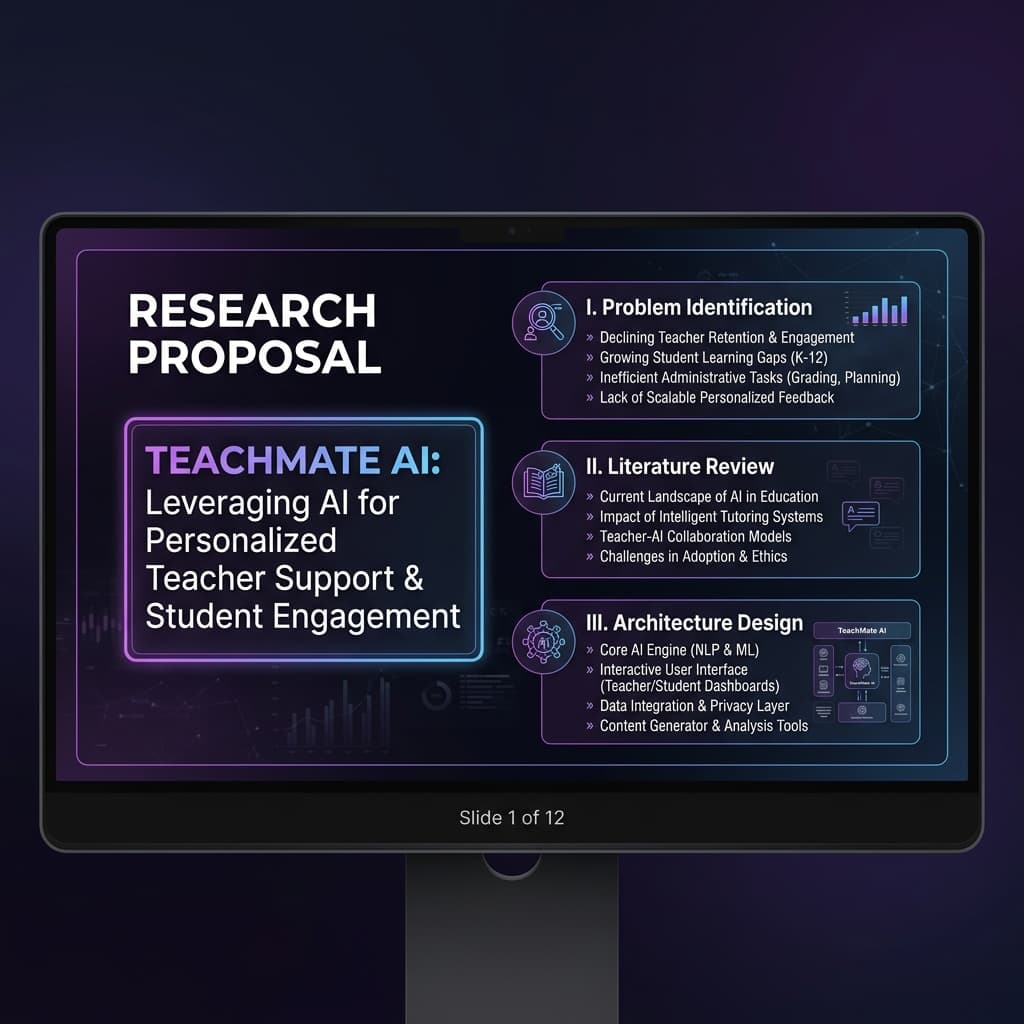
Proposal Presentation
Initial project proposal covering problem identification, literature review, proposed solution architecture, and project timeline.
Download Slides
Progress Presentation 1
First progress review demonstrating system design, initial implementation of VLM-based grading, knowledge graph prototype, and early evaluation metrics.
Download Slides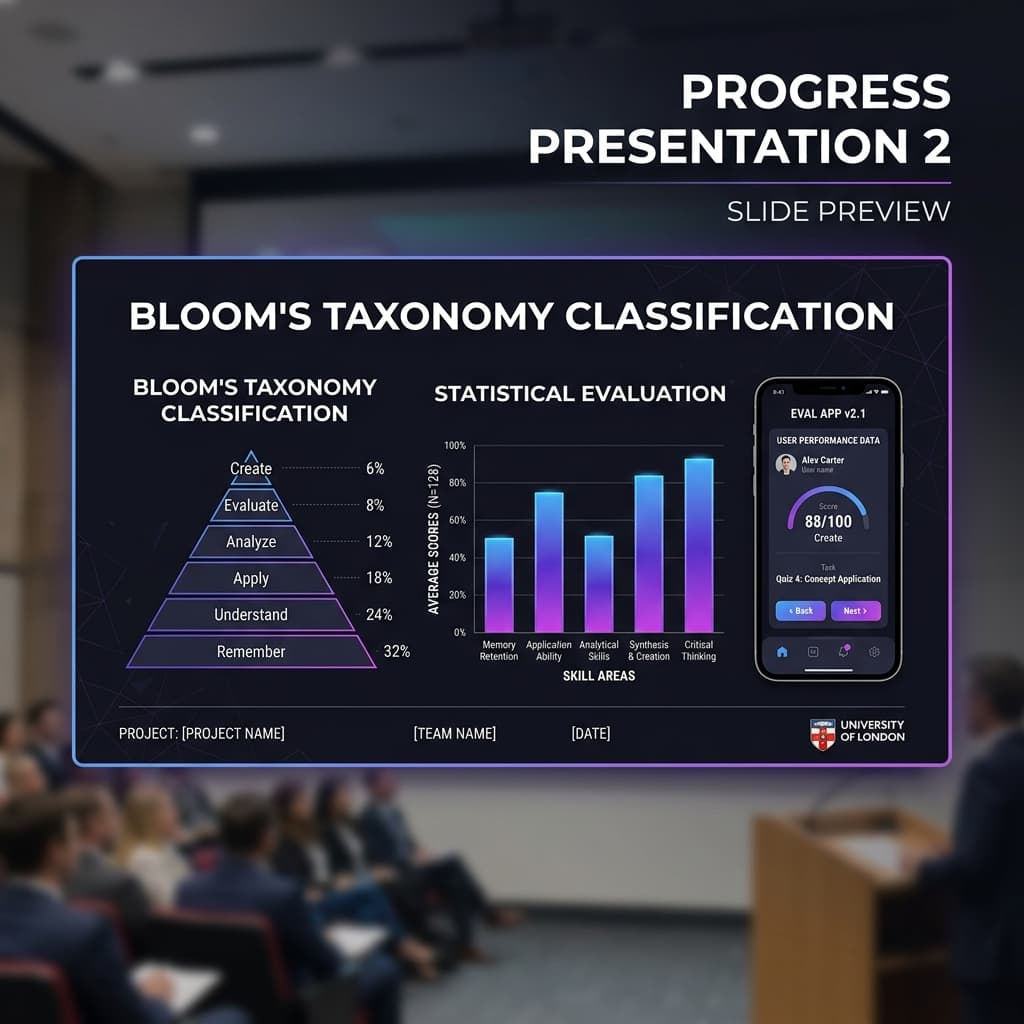
Progress Presentation 2
Second progress review showcasing integrated system testing, Bloom's classification results, mobile app prototype, and comprehensive evaluation data.
Download Slides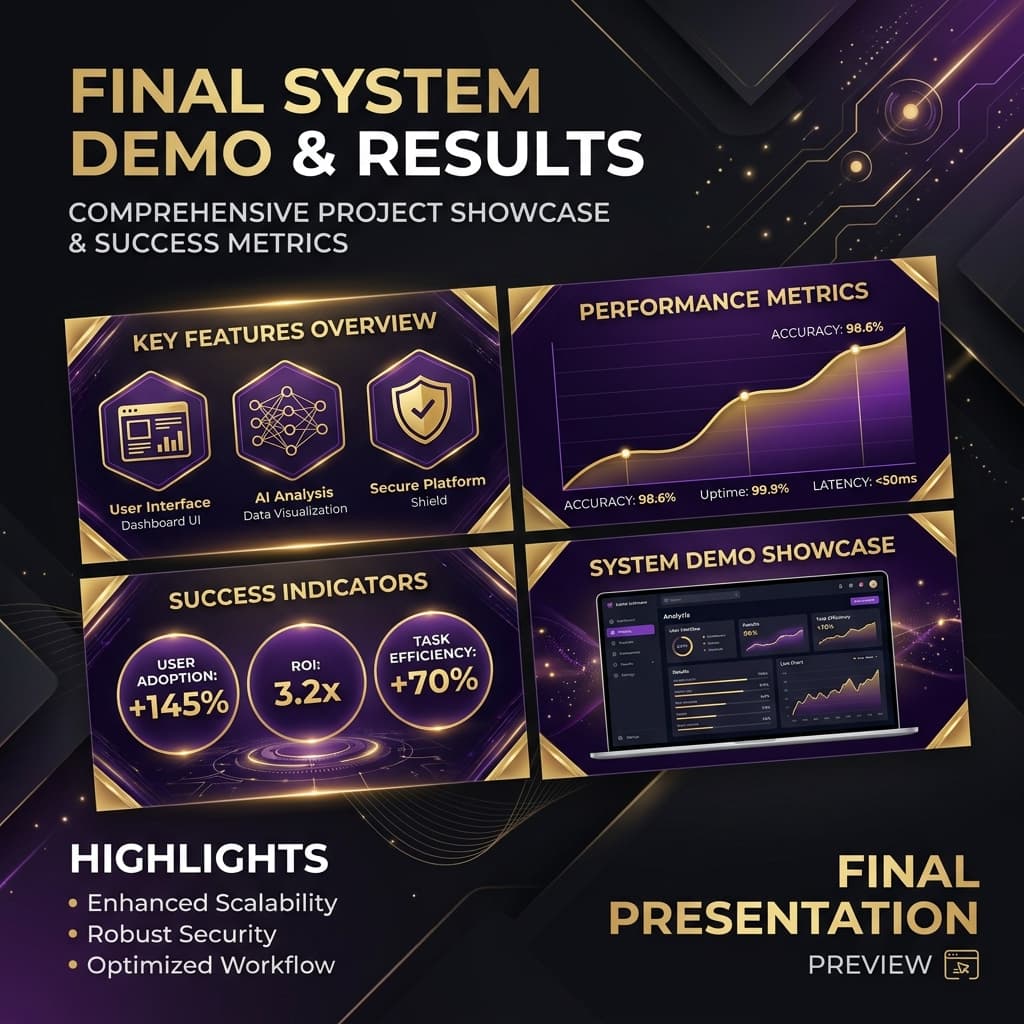
Final Presentation
Complete project presentation including final system demo, research results, statistical analysis, and future work recommendations.
Download SlidesMeet Our Team
Undergraduate researchers from the Faculty of Computing, Sri Lanka Institute of Information Technology (SLIIT), Malabe.

Pathiraja P.U.M.
VLM-Based OCR & AI Grading
Led development of VLM-based grading system using computer vision, OCR, and AI-powered educational technology.
ushanmihiranga2017@gmail.com
Wanniarachchi W.A.P.M.
Knowledge Graphs & BKT/GNN
Led development of knowledge graph and BKT/GNN reteaching guidance module with expertise in graph neural networks.
malshanwanniarachchi001@gmail.com
Hettiarachchi R.H.
Bloom's Taxonomy Question Gen
Led development of Bloom's Taxonomy-aligned question paper generation, specializing in NLP and automated assessment.
ridmihansini97@gmail.com
Jayasooriya L.T.
Personalized Learning Plans
Led development of personalized learning plan generator and mobile application with focus on recommendation engines.
lashinijayasooriya3@gmail.com

Contact Us
We welcome collaboration opportunities, feedback, and inquiries about TeachMate AI and its applications in education.